Iceland
Vatnajökull
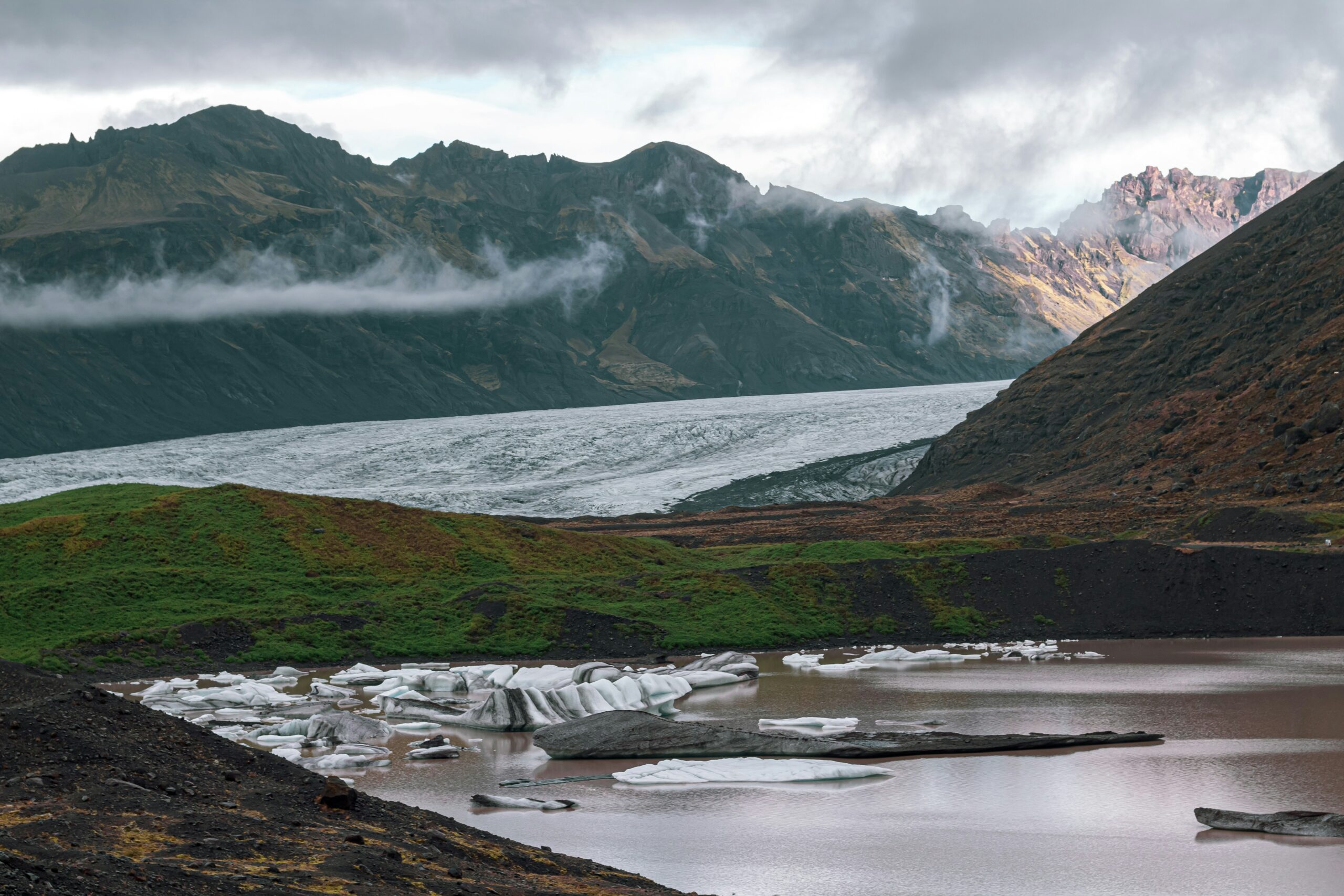
Glacier field work on Vatnajökull, Iceland’s largest ice cap, is both demanding and rewarding. Researchers face harsh weather conditions, including sudden storms, high winds, and whiteouts, making travel and measurements challenging. Field teams often live in remote huts or tents for extended periods, far from amenities, relying on careful planning and resilience. Despite the tough conditions, this work is vital for monitoring glacier changes and understanding climate impacts in one of Europe’s most dynamic glacial environments.
Contact
The maritime climate in Iceland, heavily influenced by warm ocean currents from the south, brings high variability in weather conditions. Over the past century, Iceland has experienced significant warming, especially in winter, with an average temperature increase of 1.0°C per century. Precipitation has also risen, contributing to both snow accumulation and meltwater production on glaciers. These climatic changes, along with warming ocean temperatures around Iceland, have accelerated glacier mass loss.
On Vatnajökull and other major ice caps, field work focuses on measuring glacier mass balance, melt rates, and meteorological conditions. A network of automatic weather stations (AWS) is deployed during the melt season (May–October) to monitor surface energy balance and climate. These stations are maintained by the Institute of Earth Sciences, University of Iceland, and Landsvirkjun (National Power Company of Iceland), which relies heavily on glacier-fed runoff for hydropower – over 72% of Iceland’s energy production.
Field work on Vatnajökull, Europe’s largest ice cap, is a demanding endeavor shaped by Iceland’s harsh weather, remote landscapes, and rapidly changing climate. Researchers often spend weeks in isolated glacier camps, with access only by snowmobiles and super trucks. Living conditions are basic, and teams must endure frequent storms, high winds, and sudden whiteouts that make both travel and data collection difficult and potentially hazardous.
Field scientists install ablation stakes, dig snow pits, and use GPS and ground-penetrating radar to measure snow accumulation and ice thickness. These observations are crucial for understanding the glaciers’ response to ongoing climate change. As part of the CryoSCOPE project, Landsvirkjun contributes by collecting 10-meter ice core samples from Vatnajökull. These samples will be analyzed by FMI to assess impurity amounts, with a particular focus on dust and carbonaceous particles that influence snow albedo and accelerate melt processes. Since the end of the Little Ice Age around 1890, Icelandic glaciers have lost about 16% of their total mass, equivalent to 1.5 mm of global sea level rise. Nearly half of this loss has occurred since 1994, with an especially rapid retreat between 1994 and 2010.
Despite the tough conditions, this work is essential. Not only does it provide a detailed understanding of glacial processes and climate impacts in the North Atlantic, but it also supports critical infrastructure planning in Iceland’s hydropower sector. Projections indicate continued glacier volume loss of 40–50% by the end of the 21st century, which will profoundly affect water availability and energy systems.